Introducing Malcolm Gardiner

We are proud to collaborate with Malcolm Gardiner, the president of the Land and Water Resources Otway Catchment (LAWROC).

10790764-3x2-700x467
Malcolm Gardiner at Big Swamp
Posted 
Malcolm Gardiner at Big Swamp, a former wetland that was turned into an acid soil wasteland.
Photo courtesy of ABC South West Vic: Matt Neal     Available at https://www.abc.net.au/news/2019-11-12/malcolm-gardiner-at-big-swamp/11682278

LAWROC is a Landcare group which is actively involved in Barwon fighting for the protection on the Victorian Wetlands, specifically rivers and creeks in part of the Otways, south of Colac.

The desire to leave this world in a better shape than it has been found has been my major driving force.  A lack of truth, honesty and integrity from those authorities left with the task of looking after the world of the future has also been a driving force behind trying to look after at least one small area of the planet. – Malcolm Gardiner

Malcolm recently appeared on The Sustainable Hour and you can listen to the interview here: https://climatesafety.info/thesustainablehour303/.

He will participate in the Mangroves from the Water exhibition in Geelong, by displaying his books and hosting special talks. More information will be shared soon!


Why protect the mangroves?

Mangroves and Marshes are key in the climate change battle!

Here are some factual information, sourced from The International Union for Conservation of Nature (IUCN) ‘s website (posted 2 Feb 2017)

With the advent of green technologies, it is easy to view the battle against climate change as one for the tech world. A lesser-known but increasingly recognised solution lies in nature. According to a new scientific paper, the wetland ecosystems lying along the coasts of our oceans are particularly good at sequestering and storing carbon – and the world’s governments should take full advantage of this potential through carbon finance and policy, writes IUCN’s Dorothée Herr, the paper’s co-author, on World Wetlands Day.

Recent scientific advances have demonstrated that coastal wetlands – mangrove forests, tidal marshes and seagrass meadows – are incredible long-term carbon sinks, storing carbon in the plants themselves but more importantly in the soils below for hundreds to thousands of years. In fact, the same area of coastal wetlands can be more efficient as a carbon sink than most terrestrial forests. Every year more policy and decision makers invest in ‘coastal blue carbon’ by using wetland conservation and restoration as a natural solution to meet international greenhouse gas commitments.

The carbon sequestration potential of coastal wetlands sparked interest in whether other coastal and marine ecosystems, such as coral reefs, kelp forests, phytoplankton, and marine wildlife, can similarly help in climate change mitigation. Do these marine ecosystems serve as long-term carbon sinks, and should they be considered in climate mitigation strategies?

It appears that the answer is no. Coastal wetlands are truly unique among marine and coastal ecosystems in their ability to mitigate climate change – that is the conclusion of an analysis we published yesterday in Frontiers in Ecology and the Environment. Based on our understanding of how carbon moves through kelp forests, marine life and other marine ecosystems, it seems they cannot help us mitigate climate change. Kelp and marine wildlife are not long-term carbon sinks, only holding carbon for their lifespan which may be weeks to decades. Phytoplankton do represent a long-term carbon sink due to the sheer abundance of these small photosynthesising plants, but our ability to impact the amount of carbon they remove from the atmosphere is limited. And, as phytoplankton and marine wildlife are found in the open ocean, they are not easy for national governments to manage.

But we must not forget that these marine ecosystems play a vital role in the carbon cycle of the ocean overall. They also provide many other ecosystem services to people, including coastal protection, habitat, food security, biodiversity and tourism income and we must protect them.

Our findings confirm that the climate change mitigation efforts of national governments should focus on coastal ‘blue carbon’ ecosystems, which provide critical and manageable carbon sinks under existing climate policies and mechanisms. Policy makers should continue to access carbon finance and policies to better manage coastal blue carbon.

Every year, extensive areas of coastal wetlands are lost. When they are converted to other uses or degraded, these ecosystems turn from net carbon sinks into sources of carbon, and much of the carbon stored in the soils beneath them is released back into the atmosphere and ocean.

This is why conserving, restoring and sustainably using coastal wetlands is crucial in the battle against climate change. On World Wetlands Day and beyond, it is in our interest to protect and restore them.

The paper, “Clarifying the role of coastal and marine systems in climate mitigation”, included contributions from the University of Maryland, Conservation International, IUCN, the National Center for Atmospheric Research, the Nature Conservancy, and Restore America’s Estuaries. This work was supported by the Prince Albert II of Monaco Foundation.

( this post also appeared in The Huffington Post).

World Wetlands Day is February 2nd.

World Mangroves Day is July 26th.

Did you know…?

Did you know….

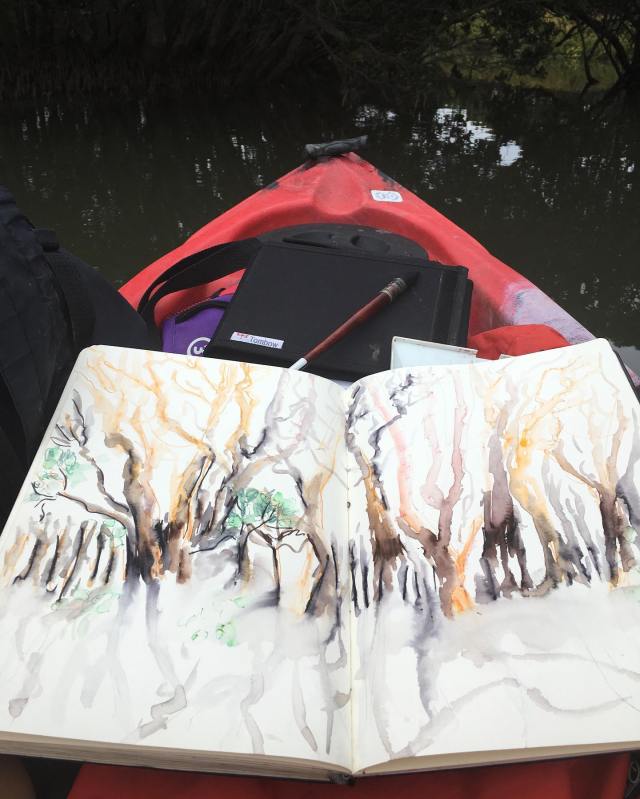
Not only does our curator Zahidah Zeytoun Millie lead and organizes the Mangroves from the Water exhibition, while painting from her kayak in the mangroves…

70418856_1409173779231665_3978412770172338176_o

…she also hosts a weekly radio talk show on 94.7 FM The Pulse ! Tune in!! She will be interviewing participating artists soon!

49897543_1230351203780591_1006617730045968384_o49864939_1230351243780587_3935408198940360704_o

Announcement from our curator Zahidah

I am happy to announce about the multimedia ‘Mangroves from the Water in Geelong’ exhibition to open on the Mangroves Day, 26 July, 2020 at the Gordon Gallery, Deakin University, Waterfront.
The Mangroves from the Water project members believe that through their art they can build awareness of the importance of protecting this important natural ecosystem.

Art has a power to inform any culture about ideas that matter.


The project members approach the theme with a fascinating range of media: painting, short film, textile, sculpture, performance dance, performance music and an art installation. The mangrove artists and our quest speakers will present a fascinating approach to celebrating the wonders of this unique habitat through art and science.


More information about the exhibition and artists involved to be announced by May 2020.

Do tune in to Masainakum Masoonah on 94.7FM The Pulse, where I will interview participating artists in July!

Zahidah Zeytoun Millie

Announcing our collaboration with the Barwon Estuary Project

Mangroves from the Water exhibition is happy to collaborate with Barwon Estuary Project in Barwon Heads to join the world celebration of the mangroves and wetlands on the International Mangroves Day.

21371243_1446247645411496_5621743934769179877_n

The Barwon Estuary Project aims to increase their community’s knowledge and appreciation of the biodiversity and fragility of the local treasure, enabling all to care for it more effectively.

68798357_2366816536687931_2723535652560830464_n

Get involved locally: The project team is calling for participants to record their Estuary observations online or in a customized diary, attend workshops, guided walks and expert talks, and have an opportunity to contribute to a creative community publication.

To read more about the Barwon Estuary Project, visit their blog.

Announcing our collaboration with Ocean Tree Studios

Mangroves from the Water exhibition is happy to collaborate with Ocean Tree Studios in Florida, USA to join the world celebration of the mangroves and wetlands on the International Mangroves Day.

23632502_163762900884818_2380136781629595529_o

Ocean Tree Studios is an environmental conservation organization founded in 2017 by Maya Greven (Founder, Creative Director).

Their mission is inspired by the magnificent mangrove, the tremendous legacy of Doris Leeper and the cross-pollination of art and science. They are dedicated to inspiring sustainable behavior, healthy habitats, expanding living shorelines and promoting the use of native plants through educational outreach and land conservancy programs that utilize the arts, culture and community-engaged design for the benefit of the Indian River Lagoon and for the greater public health of the surrounding communities.

“We believe that in restoring our landscape, we are restoring ourselves. Through community engagement, collaborative and creative efforts we hope to promote and further conservation efforts.” – Maya Greven


And so does the Mangroves from the Water team!


Reminder: ‘Mangroves from the Water’ is a group multimedia art exhibition will open on the International Mangroves Day 26 July and will end on 15 August on the opening day of the National Science Week, 15-23 August.

A glimpse into the creative development process of Jacqui Dreessens

It is always interesting to know how artists/performers derive at their final works. We thank Jacqui for giving us a glimpse into her creative process, translating the inspiration from the natural mangrove environment by using images and words and ultimately transforming it into a physical dance performance.

84740350_2966841470027289_8804458592003424256_o
Jacqui in the mangroves

Writing poetry about the Ecology of Place is vital for Jacqui’s dance making process. To begin to describe her sense of place, Jacqui uses verbs, adverbs, adjectives and alliteration.

72315757_2715476391830466_9108110262979788800_o
Breathe
Upwards
Rooted
Down
MuddyWaters
Clear
Skies
Alive

This helps to unpack her experience from being in and amongst the mangroves while floating in a kayak. These words become the launching pad for movement improvisations in the dance studio.

84414902_2966842353360534_6574481532918956032_o
Seeing inwards
Feeling downwards
Breathing outwards
Growing skywards

Jacqui develops the bodily shapes and movement transitions based on the mangroves, expressing her sensory experiences and memories through the physical bodily form.


For more information, please do visit and follow her on:

https://www.facebook.com/wildmovesinternational/

https://www.instagram.com/wildmovesinternational/       

Mangroves Information signs, kindly provided by HCT-SJW

In collaboration with the Higher Colleges of Technology (HCT)- Sharjah Women’s College, information signs were created and placed in various parts within the UAQ Mangroves to educate and inform visitors of the purpose, life cycle and animals in habitat within the mangroves. We are happy to share these here:

Mangrove UAQ_2_15Jun17

We are very grateful to HCT for their efforts!